
The Unified Payments Interface (UPI) has completed a decade since its launch, becoming the backbone of India's digital payments ecosystem. It has seen exponential growth in transaction volume and value, expanding financial inclusion and setting a global benchmark for real-time payments.

Former Reserve Bank Governors do not seen any harm in central bank consulting the government before firming up monetary policy initiatives saying such an step would not amount to infringement on its independence.

Raghuram Rajan, who was Chief Economic Advisor in the Finance Ministry before taking over as RBI Governor on September 4, is scheduled to announce the next mid-quarter policy review on December 18.

The year 2022 saw the Reserve Bank of India (RBI) start acting on the policy repo rate after a gap of two years. The six-member monetary policy committee of the RBI reduced interest rate sharply - by 115 bps - when Covid-19 struck in 2020. In March 2020, days after the nationwide lockdown was announced, MPC in an unscheduled meeting reduced the repo rate by 75 bps, followed by another 40 bps in May. Status quo was maintained for the next two years since the May repo rate hike.

rediffGURU Vipul Bhavsar answers readers' personal income tax queries

FPIs have already withdrawn Rs 2.6 trillion from Indian equities in 2026, exceeding the outflows recorded in any previous full calendar year.

Reserve Bank of India (RBI) Governor Sanjay Malhotra stated that recent regulatory measures to address foreign exchange market volatility, such as capping banks' net open positions, are temporary and aligned with current market conditions, not signalling any structural shift in policy.
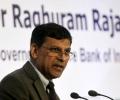
We may now be experiencing the darker side of the massive monetary stimulus of past years, said Rajan.

"Policy sales will be one of the focus areas for the company because looking at the large insurance gap, large number of people being uncovered. The only right way to go is to increase the number of policies," said Amit Jhingran, MD & CEO, SBI Life Insurance.

'It is not because of the war in West Asia, which began on February 28.' 'Petroleum product prices are already going through the roof. They are bound to have a serious inflationary impact.' 'A country's leadership is tested in trying times. It is here that the current leadership is failing.'

'Banking is the only sector that can see double-digit growth in FY27.'

'The prohibition regime has been accompanied by concerns regarding the expansion of the illicit liquor trade, increased enforcement challenges and corruption, and the growing use of alternative intoxicants, including illicit drugs.'

'Why not aspire for 8 or 9 or even 10 per cent?'

Verify a content creator's Sebi registration, qualifications and certifications before acting on their advice.

There is no shortage of liquidity, so interest rates in the overnight call money market continue to stay below 1 per cent.

The Indian rupee rebounded 50 paise from its all-time closing low to settle at 96.36 against the US dollar, driven by retreating crude oil prices, signs of easing geopolitical friction, and likely central bank intervention.

The consumer price index (CPI)-based inflation hitting an all-time low in October would encourage the six-member monetary policy committee (MPC) of the Reserve Bank of India (RBI) to cut the policy repo rate in its upcoming December 3-5 meeting. However, the July-September GDP growth, expected to be above 7 per cent, may act as a deterrent.
.jpg)
The truth is the government and the Reserve Bank enjoy a free, frank and cordial relationship.

The Indian rupee saw a significant appreciation against the US dollar following President Trump's suspension of military strikes against Iran and the Reserve Bank of India's decision to maintain its key interest rate. Market sentiment was further buoyed by positive comments from the RBI regarding the health of the banking sector.
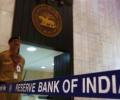
The Reserve Bank of India hiked key interest rates by 0.25 per cent each in the last two reviews to tame inflation.

'After that the burdens of an ageing population will be upon us, and the share of working age population will shrink.'

India's wholesale price index (WPI) inflation surged to 9.68 per cent in May, up from 8.26 per cent in April, primarily due to significant increases in the prices of fuel and power, manufactured goods, and food items.

'Ultimately, everything has to be shared. That's why you have that talent. To share it. Unless you share, it won't continue.'
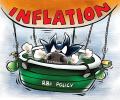
The Indian government has extended the Reserve Bank of India's (RBI) mandate to maintain retail inflation at 4 per cent, with a tolerance band of 2 per cent on either side, for another five years until March 2031.

Bank of Baroda economists project India's GDP to grow 6.5-6.8 per cent in FY27 but warn that the fiscal deficit could overshoot the budgeted 4.3 per cent target, potentially reaching 4.7-4.8 per cent of GDP due to subsidy overruns, excise duty cuts, and oil marketing company losses.
Post workers are collecting data that determines the level of India's consumer price index, which is likely to become RBI's most important tool for setting monetary policy.

India's banking system is grappling with a persistent liquidity surplus exceeding Rs 5 trillion, driven by significant government spending and bond redemptions, leading market participants to anticipate the Reserve Bank of India will step up Variable Rate Reserve Repo operations to manage the excess funds.

State Bank of India Chairman C S Setty has expressed support for a 'pause' in policy rates by the Reserve Bank of India's monetary policy committee, believing it will help stabilise conditions and support economic growth. He also urged investors to look beyond short-term equity market movements and focus on India's structural transformation, driven by reforms and digital infrastructure.

Experts said a future rate cut would depend on the inflation.


The International Monetary Fund (IMF) has reduced India's growth forecast for FY27 to 6.4 per cent, citing the potential impact of higher energy prices offsetting the country's economic resilience. Despite this, India remains among the fastest-growing major economies.

The Union Cabinet has approved a draft bill to introduce stricter punishments for examination paper leaks, following Prime Minister Narendra Modi's announcement. This new legislation builds upon the Public Examinations (Prevention of Unfair Means) Act, 2024, aiming to curb cheating in public examinations conducted by various central agencies amidst recent controversies like the NEET and NET paper leaks.

'If the war continue for a longer period of time, it is just a matter of time before the government will pass on some of the price increases.'

The United Nations has revised downward India's economic growth forecast for 2026 to 6.4 per cent from an earlier 6.6 per cent, attributing the change to global uncertainties and economic shocks stemming from the ongoing West Asia crisis.

After a 25 basis point rate cut in December, the RBI on Friday decided to pause on the policy rate front amid geopolitical uncertainties.

"It is quite possible that the rates will remain low in the near to medium term, but that will depend on how conditions evolve," said RBI Governor Sanjay Malhotra.

Reserve Bank Governor Sanjay Malhotra on Friday said the key policy rates will remain at low levels for a long period and may go down even further.

Crude oil prices surged over 3% in futures trade after US President Donald Trump expressed doubts about the Iran ceasefire, reigniting fears of supply disruptions from West Asia and pushing Brent crude above USD 107 per barrel.

Indian markets on Dalal Street rallied sharply as easing tensions in the US-Iran conflict and stable oil prices boosted sentiment. Track Nifty 50 and BSE Sensex performance and key global triggers.

Beyond imprisonment, candidates caught cheating face cancellation of examination scores, blacklisting under China's social credit system and multi-year bans from appearing in state examinations.
